
Photo credit: Schweizer Berghilfe, Max Hugelshofer
A long-term foresight analysis is aimed at highlighting the challenges that people in mountain regions will have to overcome in 15 years’ time. Together with the GDI, Schweizer Berghilfe has turned its focus to the future with the aim of identifying its potential roles in the years ahead. In contrast to the existing five-year outlook set out in the current strategic plan, the non-profit organisation wanted to move away from established mindsets and critically re-evaluate its own role.
The four steps described below show how Susan Shaw, Head of Strategic Foresight, and Camille Zimmermann, Senior Expert in Strategic Foresight, guided Berghilfe through this process.
1. Analysis: finding one’s bearings in a complex world
The first step focused on analysing the external environment. The GDI has analysed primary and secondary influencing factors based on the long-term trends identified in the GDI Major Shifts. At the heart of this analysis was the question of which social, technological, economic or environmental shifts are opening up new and even surprising perspectives on the future of mountain regions. For example, the trend towards a "multipolar world," which could lead to disruptions in global supply chains. This alters, for example, transit corridors and the organisation of trade routes, and thus also affects traffic management in the Alpine region.
2. Outlook: individual implications for mountain communities
Based on the influencing factors from the GDI Major Shifts defined in step 1, the GDI has developed more than 70 possible implications within the specific context of Schweizer Berghilfe.
Ein Beispiel: Die globale Erwärmung könnte in Berggebieten zu einer «Klima-Gentrification» führen. Klimatisch nicht zu heiss, nicht zu gefährlich und ökologisch resilient, könnten Höhenlagen um die 1200 Metern zur strategisch wertvollsten Lage des 21. Jahrhunderts werden.
In close consultation with Schweizer Berghilfe, over 30 particularly relevant implications were selected for further assessment.
3. Prioritisation: focusing on what matters most
The question of relevance can rarely be determined in isolation. Schweizer Berghilfe representatives and external experts have assessed the 30 implications identified in the second step. In-depth discussions arose primarily in those areas where opinions differed significantly. For example, the question of whether automated media ecosystems such as AI-generated news and social media tend to sensationalise alpine risks, thereby perpetuating the romanticisation of the mountains that has been ongoing since the 19th century. Others were more of the belief that the trend towards algorithmic content is increasingly downplaying the risks posed in mountainous regions, with real-world consequences for the emergency services and the local population. The different perspectives provided valuable insights for setting priorities.
On the one hand, the implications, which were tailored specifically to us, sparked the discussion. On the other hand, I was surprised at how quickly we were able to use this as a basis to identify possible developments for the next 15 years in the workshop. We have already gained a great deal of clarity and focus in this area.
The assessments and the workshop resulted in a shortlist of 15 key implications being drawn up, which was used as a strategic framework and outlined mini-scenarios for future development. In order to broaden existing perspectives, highlight blind spots and incorporate new perspectives from outside the organisation, the GDI also held two round-table sessions. Experts from the worlds of politics and business have reflected on the mini-scenarios and answered any questions that had not yet been addressed.
4. Action: the new role of Schweizer Berghilfe
But what do these future developments and implications mean for Mountain Aid today? The aim was to systematically identify potential future roles based on the findings from the first three steps. To this end, the GDI held a workshop in which Berghilfe was guided through the process of identifying the "jobs to be done" for the ecosystem of Switzerland’s mountain regions.
The methodology proved to be extremely productive, as it has moved the focus away from existing structures and towards the actual needs, functions and added value within the future ecosystem.
The key tasks were assigned to the main stakeholders. Focus was placed on the roles that the NPO could take on in the mountain regions in the future. This includes, for example, its role as an "ambassador," the aim of which is to foster greater understanding between mountain communities and city dwellers. In its role as a "think tank," its primary task is to develop a sound basis for making better decisions that benefit mountain regions.
In order to identify specific courses of action, the tasks were analysed in greater depth to determine which might become more important in the future and which are likely to become less so. Also looked at was the matter of in which areas Schweizer Berghilfe has the scope to shape policy and in which areas the NPO’s influence is more limited. The result of this was a final matrix which sets out the future roles of Schweizer Berghilfe. It illustrates both the expectations of stakeholders in mountain regions and the strategic desirability of the respective roles from the organisation’s perspective.
A more focused look to the future
The materials produced as part of the strategic foresight process form an evidence-based footing for the strategic development of Schweizer Berghilfe. The plausible and well-founded visions for the future as well as the roles of Schweizer Berghilfe in 2040 were discussed in various formats at an event attended by just under 100 guests.
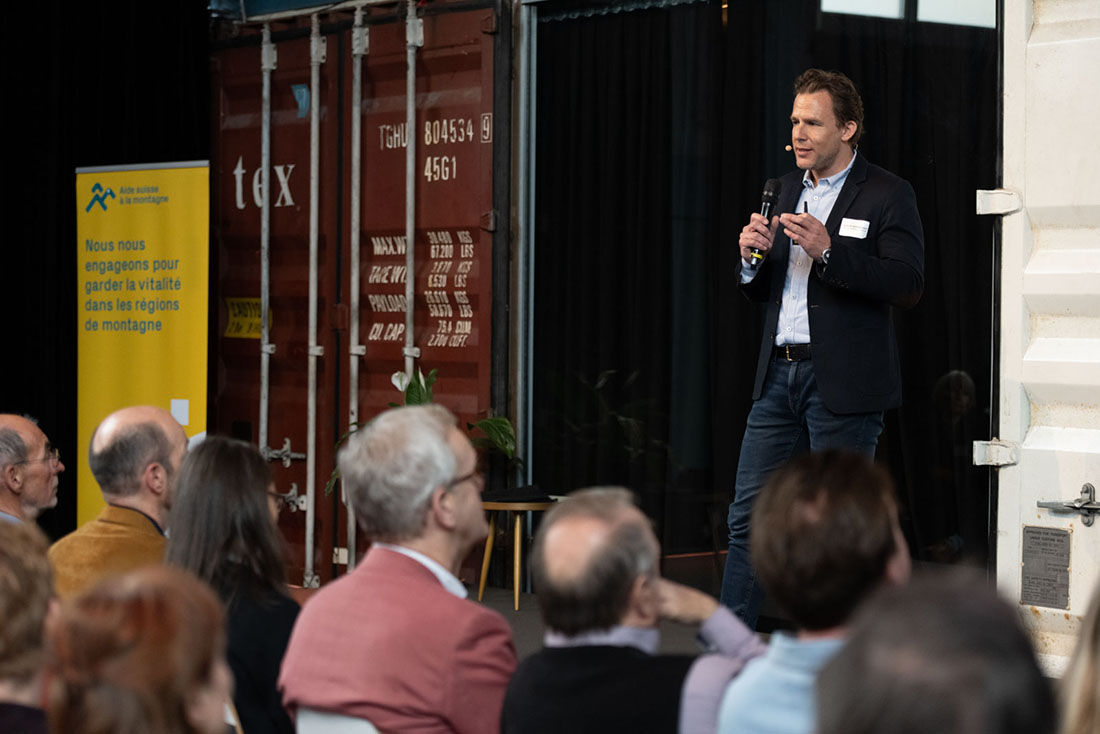
The open, inspiring atmosphere, the numerous valuable contributions and the in-depth discussions have clearly demonstrated just how important it is to think about the future together at an early stage.
"Throughout the entire process, Schweizer Berghilfe has shown that it has the courage to question the status quo and to be open to new answers to old questions," said Camille Zimmermann.