
At the International Food Innovation Conference at the GDI you will speak about making companies AI-ready. What are the biggest challenges organisations in the industry face at the moment?
Food producers are currently navigating a "perfect storm" of three interconnected pressures: rising costs, workforce gaps, and regulatory mandates linked to market expectations.
Firstly, margins continue to tighten as the costs for raw materials, energy, and freight continue to climb. This is compounded by a reliance on legacy infrastructure that often lacks the agility and efficiency needed to respond quickly. Consequently, producers must shift from focusing solely on initial capital expenditures to a comprehensive Total Cost of Ownership (TCO) model to identify long-term savings.
Second, the industry is facing a significant skills and workforce gap. Many experienced operators are retiring, and incoming talent often has less hands-on technical exposure. This talent gap creates an operational constraint that many producers are struggling to overcome. Operators increasingly need advanced and integrated decision-support tools and intuitive automation interfaces to maintain safety and productivity standards.
Finally, it is crucial to recognize that an efficient factory is inherently a more resource-efficient factory. Producers must find ways to drastically reduce water, chemical and energy consumption while minimising product waste, not only to comply with regulatory expectations but to ensure the economic viability of their operations. Improving resource efficiency strengthens resilience, protects margins, and contributes to a more reliable food supply for communities worldwide.
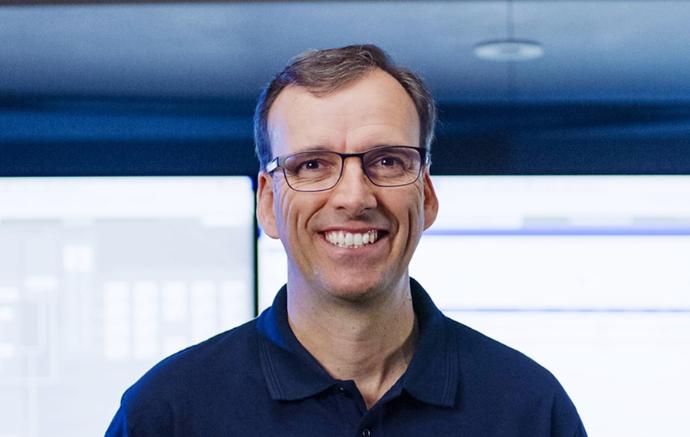
Live at the GDI food conference
Sean Sims is Vice President, Automation & Solutions at Tetra Pak and responsible for customer-facing automation and digital capabilities. He has 31 years' experience in industrial automation.
You have been working in automation for many years and experienced a variety of different industries. What learnings can you apply to your current position in the food industry?
I think the value associated with more extensive use of digital twins is a great opportunity for the Food and Beverage industry. A digital twin as a virtual "double" of your entire production line or factory that is hosted in a computer environment, mirroring exactly what is happening on the factory floor in real-time.
Think of it as a flight simulator for food production. With a digital twin, teams can analyse, simulate, and predict an equipment behaviour, process changes or optimise new recipes without stopping the physical line or wasting a single drop of product. By continuously exchanging data between the real equipment and its digital counterpart, we can spot potential breakdowns before they happen and test "what-if" scenarios to find the most resource-efficient way to operate. Ultimately, digital twins take the guesswork out of innovation, ensuring that every change we make is profitable and sustainable before we even push the "start" button.
Digital twins are also a breakthrough for workforce development. Because a digital twin is a virtual "copy" of the real production line, it creates a risk-free training environment where operators can practice and make mistakes without the high stakes of actual production. Instead of learning on a live machine where an error could cause thousands of dollars in product waste or even a safety hazard, new hires can "fly" the factory in a simulator. This is significantly cheaper than traditional training because it eliminates the need for physical prototypes and reduces the "wear and tear" on expensive assets. By allowing staff to rehearse complex scenarios—like a power failure or a rapid recipe change—we build their confidence and competence much faster, transforming our newest employees into seasoned experts in a fraction of the time.
Looking ahead five years: Where will AI transform the food industry the most and where is it overhyped?
So, this space is evolving so very quickly that it is difficult to make accurate predictions here, but I’ll try! In the next 5 years, I think AI will transform the industry in a few key ways.
Firstly, in the world of contextual decision support for humans, AI will move factory operations beyond simple alerts to provide "rigid context"—meaning it won't just tell an operator that a machine is hot, but will explain why it's happening based on the specific batch or recipe or machine condition. This turns even the most junior staff into "senior-level" experts by providing real-time guidance.
Another shift will be moving factory equipment and production process management from reactive to predictive - we will finally close the gap on unplanned downtime and manufacturing excursions, which will have a huge impact on cost of poor quality, and overall factory efficiencies.
Finally, AI will help us couple complex, interdependent processes and subsystems within a factory operation plan like never before, allowing us to tighten up a lot of the “slack” in operating capacity that is naturally created by existing systems not being able to accurately model those dependencies today, and thus creating capacity contingencies to buffer against this uncertainty. In short, much tighter, more repeatable controls with minimal variability and a higher quality of human intervention is the holy grail of production engineering, and we are finally getting the right tools to chase the dream!
At the other end of the spectrum, I believe fully “lights-out” manufacturing in Food & Beverage is largely over-hyped in the five-year time window. Will a handful of isolated factories get there? Maybe – it is technically possible. But the numbers will not be material. Similarly, “data lakes” where huge volumes of data are stored for “generic analysis” using pattern recognition tools is not that interesting, because, at the end of the day, chasing a problem definition through data volume is not the optimum way to deploy your valuable resources when your factory floor folks have real, tangible problems to solve right now. It’s great for data storage companies, but not for your bottom line.
Finally, what is your message for companies that want to introduce AI because «everyone else is doing it, so we should, too»?
In a recent podcast discussing digitalisation, I talked a lot about “a hammer looking for a nail”, and that is exactly what you are describing here. Artificial Intelligence is just complex mathematics and patterns between data sets – it is not the magic answer to everything. Companies who have not clearly identified and articulated the business problem that they are trying to solve before selecting the tool to use risk spending a lot of time and money chasing a result that will never be delivered.
Our formula for success here is quite simple, actually.
- Start with the problem(s) you are trying to solve. Unpack the causes, constraints and disturbances around the problem and be able to articulate them effectively
- Quantify the value: Prioritise challenges that deliver the highest return when solved
- Choose the right tools: This may include revised process workflows, additional automation, data collection and visualization, statistical analysis, embedded decision support tools, AI, and many others
- Invest in change management: Whatever the solution, one thing is a certainty; without the right change management scaffolding the solution, new ways-of-working are infinitely more difficult to implement, and this part of the process is often the one most underestimated and undervalued, which is a huge error
- Measure, execute, validate and commit – things that we have been doing in closed loop control systems for decades!
“Recoding Food”: The GDI food conference
How can you future-proof your business? At GDI, we explore how AI is becoming the new operating system of the food industry. Join us on 18 June and exchange ideas with leading experts and thought leaders at the International Food Innovation Conference.