
The images of Trump, Putin and Xi discussing international security issues together on the sidelines of the Asia-Pacific Economic Cooperation (APEC) summit symbolise the shift in the global balance of power. (1) Yet this shift extends well beyond these three great powers: a US-centred order is giving way to a world with multiple poles of differing weight and influence.
Joschka J. Proksik
Senior Researcher and Speaker, GDI
As a political scientist, he analyses geopolitical shifts and economic dependencies, with a particular focus on critical resources, global trade and strategic technologies
More about the author
While the United States and China remain by far the most important centres of power, the world is not simply dividing into two rival blocs.Russia remains a major military power. The EU is a major economic and regulatory power, although its ability to act in foreign and security policy remains limited. India is gaining influence, as are regional powers such as Brazil, South Africa, Indonesia, Iran and Turkey. These actors pursue their own interests and form different coalitions depending on the issue. New alliances and cooperation arrangements, competing institutions and overlapping regional claims to influence are shaping this complex order.
The Changing Economic Balance
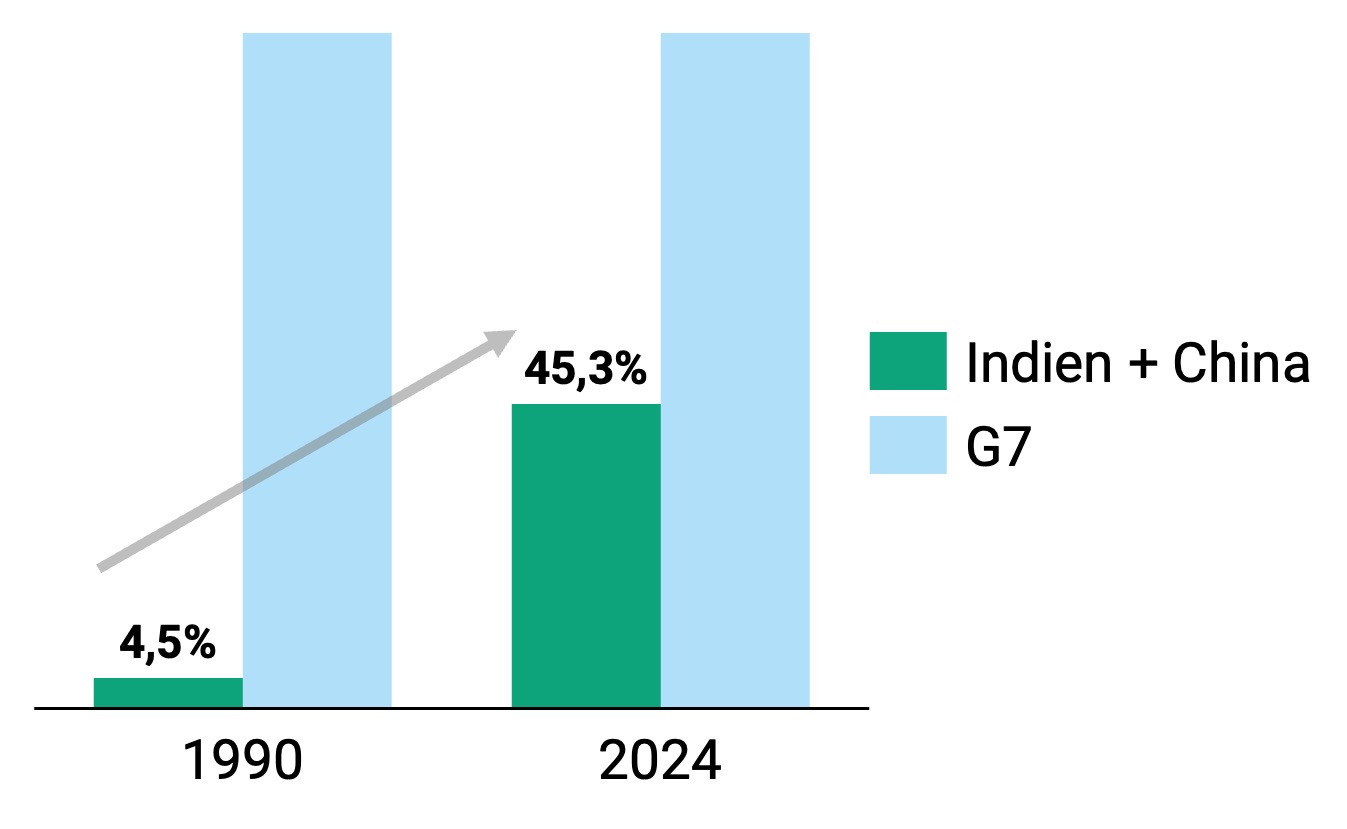
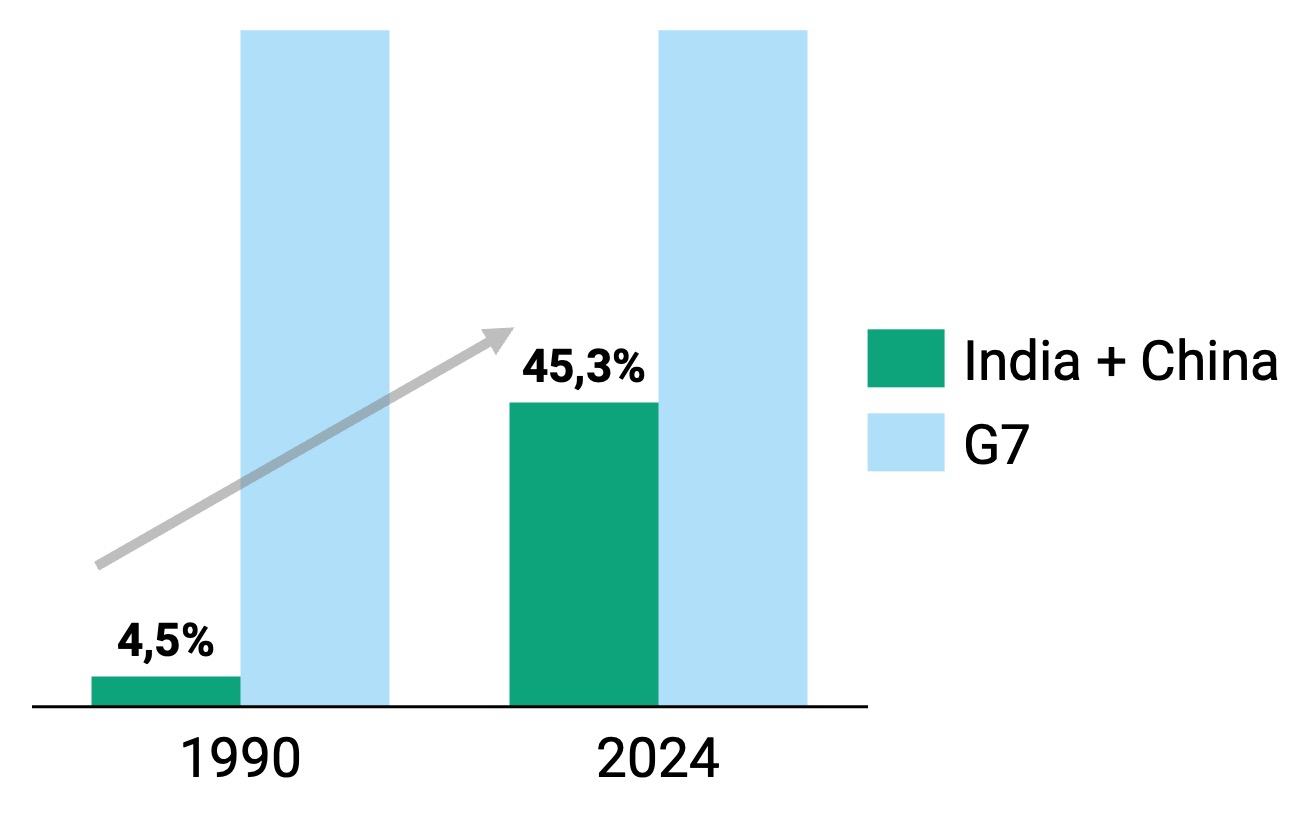
A comparison of China and India with the G7 illustrates just how significantly the balance of economic power has shifted: In 1990, their combined economic output, measured in terms of nominal GDP in current US dollars, was about 4.5 per cent of that of the G7. By 2024, that figure had risen to about 45 per cent. Their relative economic weight has thus increased nearly tenfold.
China und Indien: Wirtschaftsleistung im Verhältnis zur G7
China and India: Nominal GDP Relative to the G7
BRICS+ überholen die G7 beim Anteil an der Weltwirtschaft
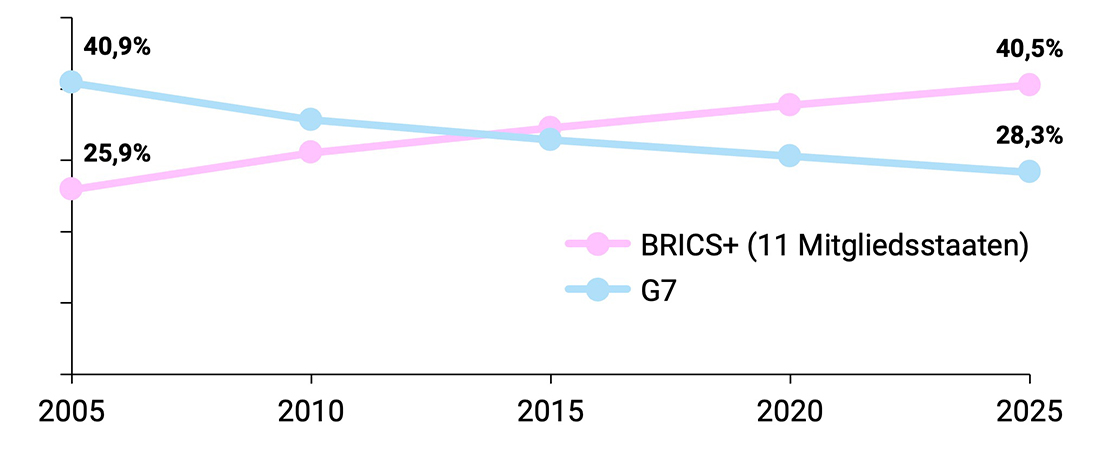
BRICS+ surpass the G7 in share of global GDP
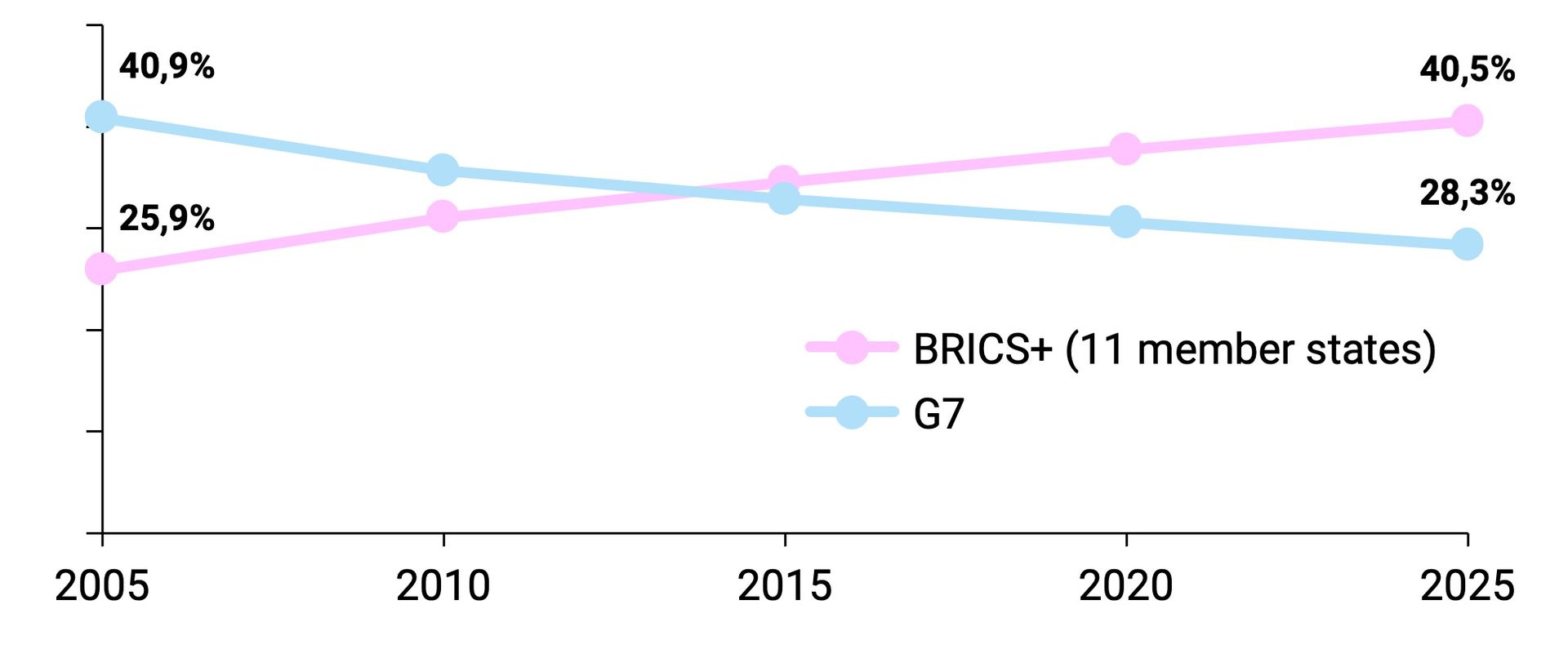
The changing economic balance is also evident in the growing trade within the Global South: Trade in goods between emerging and developing economies rose from 2.3 to 5.6 trillion U.S. dollars between 2007 and 2023. (4) As their economic weight grows, so does their demand for stronger representation.
Looking Back: The Global Order since 1945
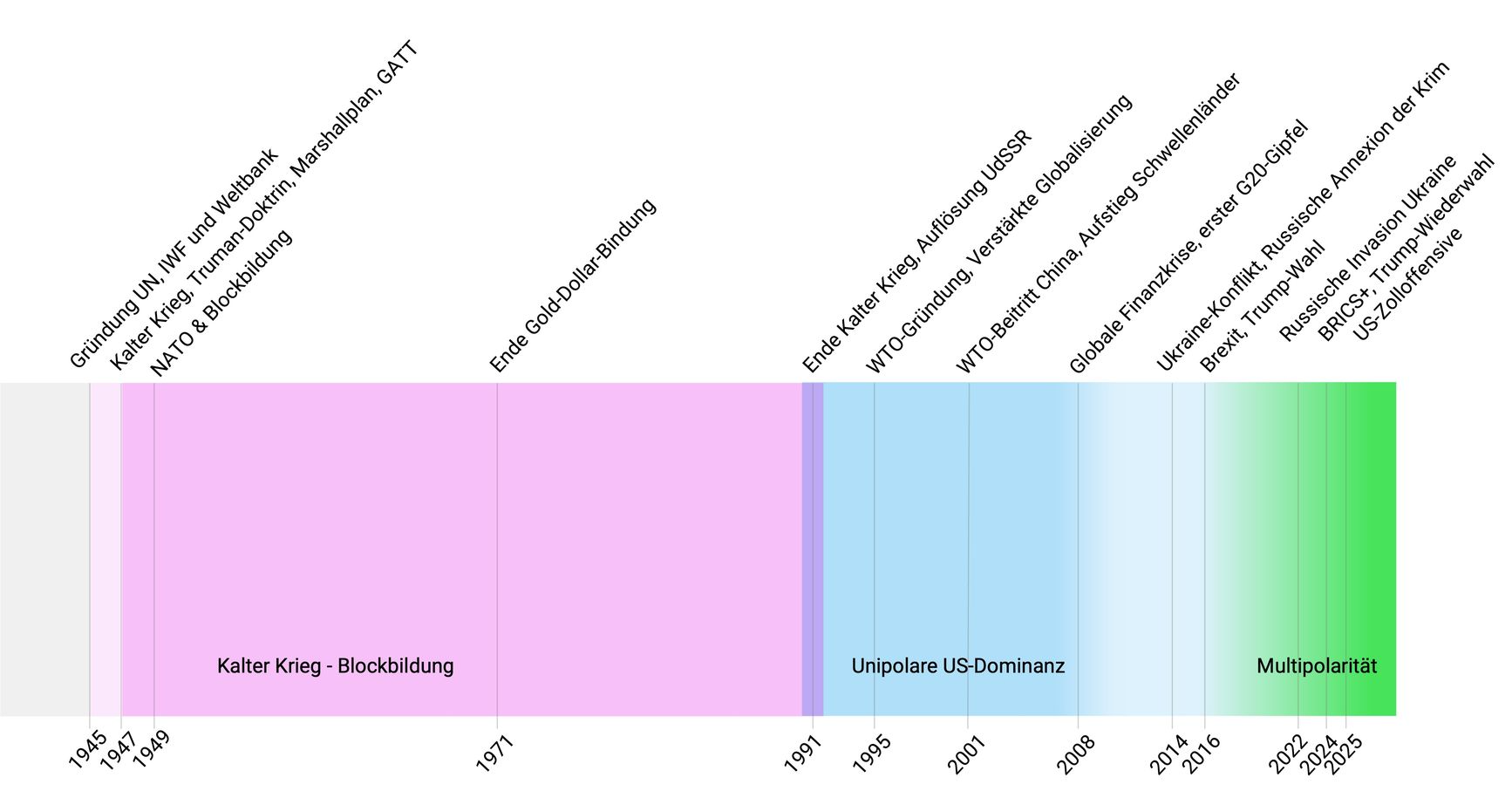
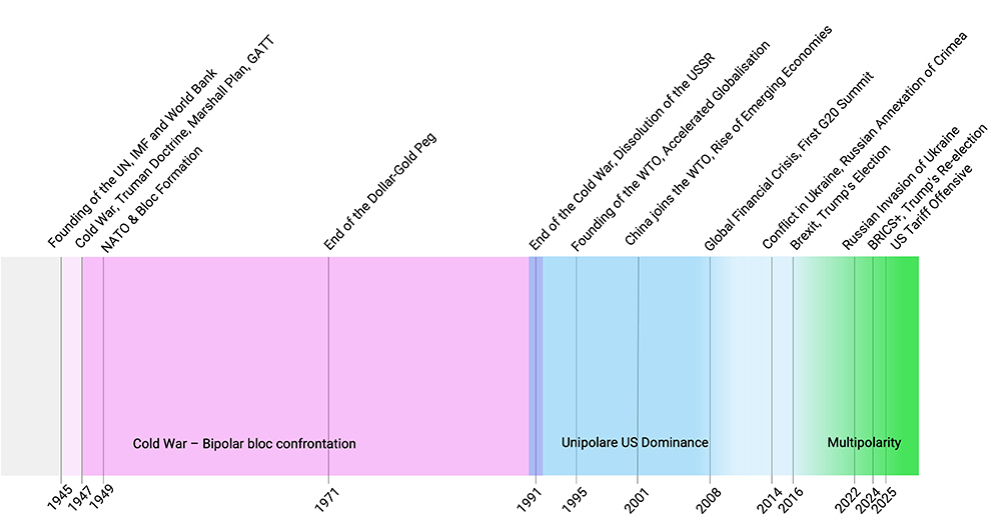
The bipolar rivalry between the United States and the Soviet Union was followed by the so-called unipolar moment after the Soviet Union's collapse in 1991. For roughly two decades, the United States enjoyed a historically exceptional combination of economic, military and institutional power.
Since the late 2000s, this configuration has been eroding. China's rise, the growing autonomy of regional powers and Europe's relative loss of influence are reshaping the global distribution of power. Fewer and fewer international issues can be settled by a single great power or a fixed bloc.
Globale Ordnung im Wandel seit 1945
The changing global order since 1945
Historically, such a configuration is not new. The European state system of the nineteenth and early twentieth centuries was also characterised by competing great powers and shifting balances of power. Such orders can endure for long periods but remain vulnerable to rivalry and tensions. What is new, then, is not so much the existence of multiple power centres as the waning of America's once-unrivalled dominance.
Military Power Is Becoming More Diffuse
New military technologies are changing the dynamics of military power. Drones, missiles, and relatively inexpensive precision-strike systems enable even smaller actors to inflict heavy costs on superior adversaries.
This is evident from the Houthi movement’s attacks on shipping in the Red Sea and Saudi energy infrastructure, Iranian missile and drone attacks on U.S. military bases in the Gulf region, and the use of low-cost drones in the war in Ukraine.Beyond military targets, critical infrastructure and trade routes are increasingly coming under attack. Disruptions to supply chains and transportation can trigger economic consequences that far exceed the direct damage caused.
In this way, even weaker actors can credibly threaten retaliation and raise the costs of military operations. This makes it increasingly difficult for militarily superior powers to translate their military capabilities into political success through the use of force.
Global Fragmentation
Shifts in the global balance of power are putting international institutions under pressure to change. Many of these institutions were established under the fundamentally different balance of power that existed in the pos-twar era. Calls for reform of the United Nations, particularly the Security Council, as well as the IMF and the World Bank, have therefore accompanied the rise of new powers for years. (5)
At the same time, new institutions and cooperative frameworks such as BRICS, the New Development Bank (NDB), the Asian Infrastructure Investment Bank (AIIB), and the Community of Latin American and Caribbean States (CELAC) emerged. Some were created as alternatives to Western-dominated institutions, while others serve primarily to facilitate regional cooperation. They open up additional financing and policy options, as well as forums in which the United States and Europe do not automatically set the agenda.
Meanwhile, the network of regional trade agreements continues to expand. (6) Although this regionalisation is not necessarily driven by geopolitics, it distributes economic ties and institutional capacity for action more widely across various centers.
States are also increasingly aligning their economic relations with strategic interests. They are reducing dependencies, relocating supply chains and restricting the exchange of technology. So far, however, there are no signs of a clear division into distinct economic blocs. Rather, regional and strategic interdependencies overlap with transactional cooperation across political divides.
The result is not a unified new order, but a fragmented web of relationships and institutions. Countries gain more options when choosing their partners and forms of cooperation. At the same time, existing relationships may become less reliable.
Individuals, organisations and businesses alike often struggle to accept new realities. Our work in strategic foresight shows that this is particularly true of the shift towards a new multipolar world. Yet a return to “the way things were” is unrealistic. Sitting back and waiting out crises is not a sustainable strategy. Just as ineffective is getting caught up in every short-term fluctuation and abandoning plans prematurely. Through our framework and proven process, we chart a well-balanced middle course: level-headed, clear, fact-based and challenging.
The Erosion of International Norms
Fragmentation also affects the norms underpinning the international order. Within the United Nations, for example, China seeks to give greater weight to sovereignty and economic development relative to liberal freedoms. (7) Other states primarily demand a greater say in shaping international rules. Efforts to reshape the existing order are increasing, as is the disregard for its rules.
At the same time, the order is eroding from its traditional centre. While the United States has long taken a selective approach to international rules and institutions, its retreat from parts of the multilateral system has accelerated under the second Trump administration. It has withdrawn from the Paris Agreement and the World Health Organization (WHO) and has once again announced its withdrawal from the United Nations Educational, Scientific and Cultural Organization (UNESCO) at the end of 2026. (8)
Two developments thus converge: rising powers want to renegotiate international rules, while the traditional leading power is less willing to uphold the existing order.
What Multipolarity Means
These shifts do not necessarily produce a stable new order. A multipolar system could remain characterised by shifting coalitions, competing claims to power and contested rules for a long time.
For states and businesses, this changes the conditions of international cooperation. Critical infrastructure and technology is becoming increasingly important both as both vulnerable supply systems and strategic instruments of power. At the same time, markets and regulatory frameworks risk further fragmentation. Companies may find themselves caught between demands from different power centres that, in extreme cases, cannot all be met simultaneously.
Although many states continue to have an interest in open markets and reliable rules, the authority of those rules is increasingly becoming a matter of geopolitical contestation. Political dependencies, informal relationships and negotiating skills are therefore gaining importance. States and businesses must increasingly assess whether their decisions will remain viable as the balance of power remains in flux.
- https://apnews.com/article/trump-xi-putin-china-apec-25e17ec8d9c55fbff960d5631eaba71d
- Perthes, Volker (2026): Die Multipolarisierung der Welt: Ein geopolitischer Wegweiser. Suhrkamp Verlag.
- EY (2026): Economy Watch. Monitoring India's macro-fiscal performance. September 2026. ey.com/content/dam/ey-unified-site/ey-com/en-in/insights/tax/economy-watch/documents/2026/09/ey-economy-watch-monitoring-india-s-macro-fiscal-performance-september-2026.pdf
- https://unctad.org/news/reshaping-global-trade-how-developing-countries-can-strategize
- https://www.nupi.no/content/pdf_preview/29333/file/NUPI_Report_12_2024_Maglia%20et%20al.pdf
- https://www.wto.org/english/tratop_e/region_e/region_e.htm
- https://link.springer.com/chapter/10.1007/978-981-10-3141-0_5
- https://www.whitehouse.gov/presidential-actions/2025/02/withdrawing-the-united-states-from-and-ending-funding-to-certain-united-nations-organizations-and-reviewing-united-states-support-to-all-international-organizations/